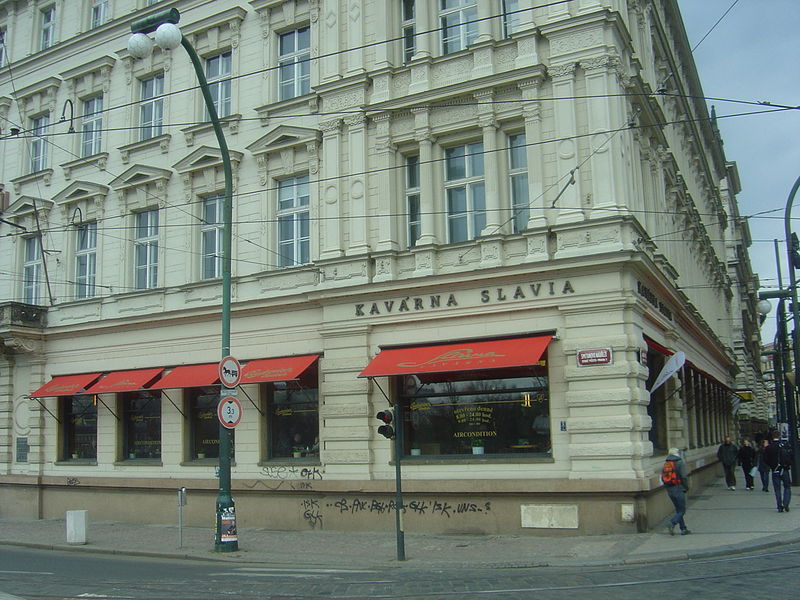
Prague has been a city of coffeehouses for well over a century. In the late 19th and early 20th centuries, the grand cafes of the city centre served as living rooms for writers, artists, and political thinkers. Franz Kafka, Jaroslav Hašek, and Rainer Maria Rilke all spent time in Prague's coffeehouses. That tradition never entirely disappeared, and today it coexists with a thriving contemporary specialty scene.
Whether you are looking for a gilded salon with marble tables and a long menu of pastries, or a stripped-back espresso bar serving single-origin pour-overs, Prague has it. This guide organises the best options by neighbourhood so you can plan your visits efficiently.
Staré Město (Old Town) and Josefov
The historic centre is where Prague's most famous coffeehouses are concentrated. Prices here tend to be higher than elsewhere in the city, but the settings are often extraordinary.

Grand Café Orient occupies a Cubist building from 1912 — one of the few Cubist buildings in the world.
Grand Café Orient
Located inside the House of the Black Madonna on Ovocný trh, Grand Café Orient is one of the most architecturally distinctive cafes in Europe. The building, designed by Josef Gočár in 1912, is one of the rare examples of Cubist architecture applied to a commercial building. The cafe on the first floor was restored and reopened in 2005 after decades of closure. The interior features original Cubist furniture reproductions, geometric light fittings, and large windows overlooking the street below. The coffee is good, the cakes are excellent, and the setting is genuinely unlike anywhere else.
Café Louvre
Café Louvre on Národní třída has been operating since 1902, making it one of the oldest continuously running cafes in Prague. It occupies the first floor of a building near the National Theatre, with high ceilings, large windows, and a billiard room that has been in continuous use for over a century. The menu covers all the classic coffeehouse staples — Viennese coffee, hot chocolate, strudel, svíčková — alongside a full lunch and dinner menu. It is a place that rewards a long, unhurried visit.
Prague's historic coffeehouses were not just places to drink coffee. They were offices, meeting rooms, and debating chambers for an entire intellectual class.
Malá Strana (Lesser Town)
Across the river from the Old Town, Malá Strana has a quieter, more residential character. The cafes here tend to be smaller and less touristy, tucked into the narrow streets below Prague Castle.

The interior of Café Louvre has changed little since its early 20th-century heyday.
Malá Strana rewards slow exploration on foot. Many of the best cafes here are found by wandering rather than searching — a small window with a hand-lettered sign, the smell of roasting coffee drifting from a basement door. The neighbourhood has a number of small independent cafes that have built loyal local followings without much online presence.
Vinohrady and Žižkov
These two adjacent districts east of the city centre are where much of Prague's contemporary specialty coffee scene is concentrated. Both are primarily residential neighbourhoods with a young, educated population and a strong appetite for quality coffee.
The specialty cafes in Vinohrady and Žižkov typically source their beans from small European roasters, use precise brewing equipment, and take their craft seriously without being precious about it. Most have a relaxed, neighbourhood feel rather than the self-conscious atmosphere that sometimes accompanies third-wave coffee culture elsewhere.
What to Order
- Espresso — the standard measure for quality; ask for it without milk to assess the roast properly.
- Flat white — widely available in specialty cafes and often made with more care than in many Western European cities.
- Filter coffee — pour-over and batch brew are both common in specialty cafes; a good way to experience single-origin beans.
- Turecká káva — Turkish-style coffee, still served in traditional cafes; strong, unfiltered, and served with a glass of water.
- Vídeňská káva — Viennese coffee, espresso topped with whipped cream; a Central European classic.
Nové Město (New Town)
Despite its name, Nové Město is one of the older parts of Prague — it was founded by Charles IV in 1348. The neighbourhood stretches south from the Old Town and includes Wenceslas Square, the main commercial artery of the city. The cafe scene here is mixed: there are tourist-oriented places on the main square, but venture a few streets away and you will find excellent independent cafes serving a local clientele.
Café Slavia
Café Slavia, on the embankment opposite the National Theatre, is perhaps the most famous cafe in Prague. It has been in operation since 1884 and has served as a gathering place for Czech cultural and intellectual life for well over a century. The poet Jaroslav Seifert, who won the Nobel Prize for Literature in 1984, was a regular. The large windows look out over the Vltava river and Prague Castle, making it one of the best views of any cafe in the city. The coffee is competent rather than exceptional, but the atmosphere is irreplaceable.
Practical Information
Most Prague cafes are open seven days a week. Historic coffeehouses typically open around 9am and close between 10pm and midnight. Specialty cafes often open earlier (7–8am) but close earlier too (5–7pm). On weekends, popular places can fill up quickly, particularly in the late morning.
Payment by card is widely accepted, though some smaller independent cafes are cash-only. It is always worth checking before you order. Tipping is not obligatory but is appreciated — rounding up to the nearest 10 or 20 CZK is the standard practice.
For further reading on Czech coffee culture, the Specialty Coffee Association publishes regular reports on European coffee markets, and Czech Tourism maintains a useful overview of Prague's cultural attractions.